Wood Stove BTU & Cords Per Winter
Enter your house, how much of it the stove heats, the stove's efficiency and what you pay per cord, and get the cords per winter and the cost next to gas.
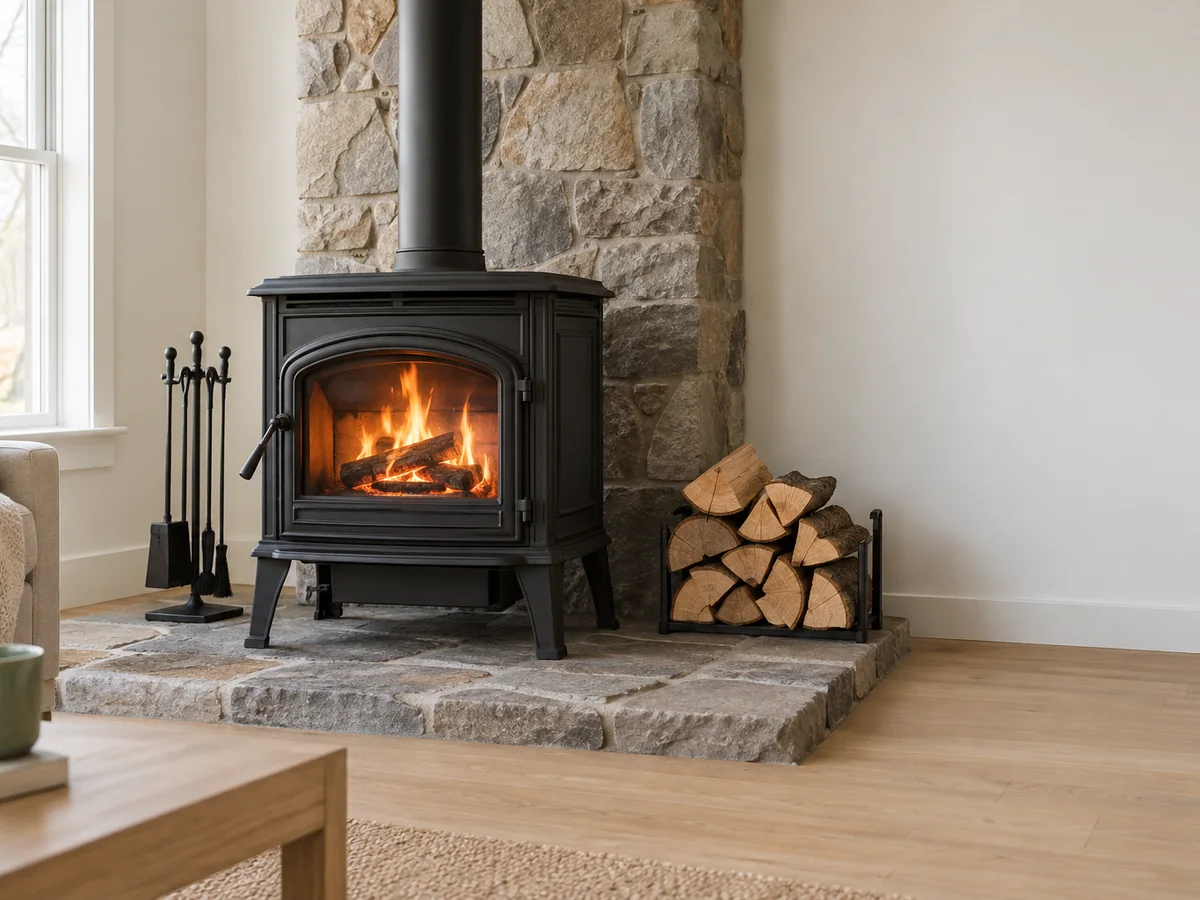
Wood stove
B08Scenario A
Sets the electricity rate. Pick US average if you're not sure.
From EIA for US average. Use the rate on your bill if you know it.
Rate used: 18.4¢/kWh · US average · EIA reference 2025–26 · gas $1.55/therm · 4,500 heating degree-days (data as of 2026-09-26) ·
Cords of wood per winter
About 3.7 cords a winter, $1,102.50 at $300.00 a cord.
- Heat to supply (MMBtu)
- 52.9
- Cords per winter
- 3.7
- Cost per winter
- $1,102.50
- Wood, $ per MMBtu
- $20.83
- Same heat from a gas furnace (AFUE 0.90, fixed)
- $911.40
Estimate. Formula and sources are under “How it works”. Change any input; the result updates as you type.
2026 note: The federal 25C and 25D tax credits ended for installations after Dec 31, 2025. Our numbers use 2026 rules. State rebates, HEAR/HOMES programs and utility programs may still apply.
Formula
How it works
- Annual heating load (MMBtu) = square feet × insulation factor × heating degree-days × 24 ÷ 1,000,000
- Heat from the stove = annual load × share heated with wood
- Cords = heat from the stove ÷ 20 MMBtu per cord ÷ stove efficiency
- Cost per winter = cords × price per cord
- Firewood $ per MMBtu = price per cord ÷ 20 ÷ efficiency
- Gas equivalent = heat from the stove × (gas $/therm ÷ 0.1 ÷ 0.90)
A cord of seasoned mixed hardwood holds about 20 MMBtu. Oak is closer to 24 and pine closer to 15, so if you burn mostly softwood, expect more cords than shown. The two things that move the answer most are your local cord price and how much of the house the stove really heats.
Sources: USDA Forest Service (heat content per cord: mixed seasoned hardwood 20 MMBtu, oak 24, pine 15); EPA 2020 wood heater standard (65–80% efficiency); NOAA CPC heating degree-day normals 1991–2020; EIA Natural Gas Prices (residential).
Worked example
A worked example
A 2,200 sq ft Wisconsin house with poor insulation, heated entirely by a 75% stove, needs about 195.4 MMBtu over the winter. That's 13.0 cords, an estimated $3,256.00 at $250 a cord. Firewood works out to $16.67 per MMBtu. The same heat from a 90% gas furnace at Wisconsin's $1.10/therm would cost about $2,387.73, so at this cord price gas is cheaper.
Reference
By state, at the default inputs
Cords of wood per winter, with this page's default inputs and each state's reference prices (EIA reference 2025–26, data as of 2026-09-26).
| US average | 3.7 cords | 18.4¢/kWh |
|---|---|---|
| Alabama | 2.1 cords | 15.5¢/kWh |
| Alaska | 8.2 cords | 25.0¢/kWh |
| Arizona | 1.1 cords | 15.0¢/kWh |
| Arkansas | 2.6 cords | 13.0¢/kWh |
| California | 2.0 cords | 32.0¢/kWh |
| Colorado | 4.9 cords | 16.0¢/kWh |
| Connecticut | 4.7 cords | 30.0¢/kWh |
| Delaware | 3.8 cords | 17.0¢/kWh |
| District of Columbia | 3.4 cords | 19.0¢/kWh |
| Florida | 0.6 cords | 15.0¢/kWh |
| Georgia | 2.3 cords | 14.5¢/kWh |
| Hawaii | 0.0 cords | 42.0¢/kWh |
| Idaho | 4.7 cords | 12.0¢/kWh |
| Illinois | 5.1 cords | 17.0¢/kWh |
| Indiana | 4.5 cords | 15.5¢/kWh |
| Iowa | 5.5 cords | 13.5¢/kWh |
| Kansas | 3.9 cords | 14.5¢/kWh |
| Kentucky | 3.6 cords | 13.0¢/kWh |
| Louisiana | 1.5 cords | 12.5¢/kWh |
| Maine | 6.0 cords | 26.0¢/kWh |
| Maryland | 3.8 cords | 19.0¢/kWh |
| Massachusetts | 4.7 cords | 29.0¢/kWh |
| Michigan | 5.4 cords | 19.5¢/kWh |
| Minnesota | 6.5 cords | 15.5¢/kWh |
| Mississippi | 1.9 cords | 13.5¢/kWh |
| Missouri | 4.0 cords | 13.0¢/kWh |
| Montana | 6.2 cords | 13.0¢/kWh |
| Nebraska | 5.1 cords | 12.0¢/kWh |
| Nevada | 2.4 cords | 15.0¢/kWh |
| New Hampshire | 6.0 cords | 27.0¢/kWh |
| New Jersey | 4.1 cords | 22.0¢/kWh |
| New Mexico | 3.3 cords | 15.0¢/kWh |
| New York | 4.5 cords | 25.0¢/kWh |
| North Carolina | 2.8 cords | 14.5¢/kWh |
| North Dakota | 7.3 cords | 11.5¢/kWh |
| Ohio | 4.7 cords | 16.5¢/kWh |
| Oklahoma | 2.9 cords | 13.0¢/kWh |
| Oregon | 3.8 cords | 14.5¢/kWh |
| Pennsylvania | 4.6 cords | 18.5¢/kWh |
| Rhode Island | 4.7 cords | 29.0¢/kWh |
| South Carolina | 2.1 cords | 15.0¢/kWh |
| South Dakota | 6.0 cords | 13.0¢/kWh |
| Tennessee | 2.9 cords | 13.5¢/kWh |
| Texas | 1.6 cords | 15.5¢/kWh |
| Utah | 4.7 cords | 12.0¢/kWh |
| Vermont | 6.2 cords | 22.0¢/kWh |
| Virginia | 3.3 cords | 15.5¢/kWh |
| Washington | 3.9 cords | 12.0¢/kWh |
| West Virginia | 3.9 cords | 15.5¢/kWh |
| Wisconsin | 6.0 cords | 17.5¢/kWh |
| Wyoming | 6.0 cords | 12.5¢/kWh |
Questions
FAQ
How many cords of wood to heat a house?
At the US-average winter, a 2,000 sq ft house with average insulation heating 70% with a 72% stove burns an estimated 3.7 cords. An 1,800 sq ft house in Maine heated entirely with wood needs about 7.8 cords.
Is wood heat cheaper than gas?
It depends on your cord price. At $300 a cord in a 72% stove, firewood costs $20.83 per MMBtu. In the US- average example the stove costs $1,102.50 a winter and the same heat from gas $911.40. In Maine, where gas is $2.10/therm, the stove costs $1,767.67 vs $1,827.50 for gas.
Hardwood vs softwood BTU?
Per cord, seasoned oak holds about 24 MMBtu, mixed hardwood about 20 and pine about 15. The calculator uses 20. Burning pine means about a third more cords for the same heat.
Does stove efficiency matter that much?
Yes. Cords scale with 1 ÷ efficiency: going from a 55% older stove to a 75% EPA-certified one burns about a quarter less wood for the same heat.
Why is my real number higher?
Wet wood. Unseasoned wood spends part of its heat boiling off water. The 20 MMBtu figure assumes seasoned (dry) wood.
Related