Heat Pump vs Gas Furnace Cost Calculator
Enter your heated square footage and how well the house is insulated, pick your state, and see what a year of heat costs with a heat pump and with a gas furnace, side by side.
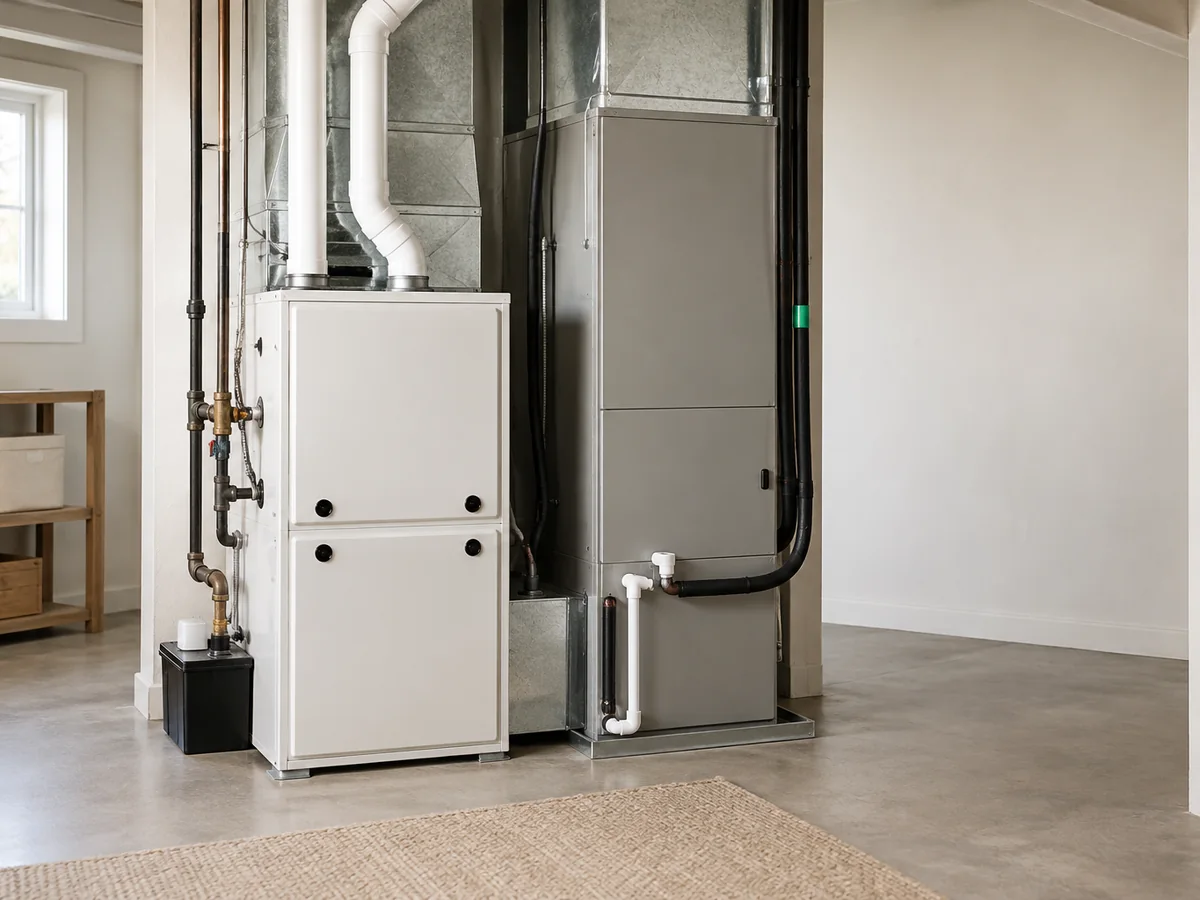
Heat pump vs gas furnace
B01Scenario A
Sets the electricity rate. Pick US average if you're not sure.
From EIA for US average. Use the rate on your bill if you know it.
Rate used: 18.3¢/kWh · US average · EIA, July 2026 · gas $1.48/therm (EIA 2025 annual) · 4,500 heating degree-days · climate zone 4 (data as of 2026-09-28) ·
On the furnace label: 0.80 older, 0.90–0.98 condensing.
Gas furnace costs less per year by
Heat pump: $1,448.92 a year · Gas furnace: $1,216.17 a year, for 75.6 MMBtu of heat.
- Yearly heating load
- 75.6 MMBtu
- Heat pump, $ per MMBtu
- $19.17
- Gas furnace, $ per MMBtu
- $16.09
- Heat pump, per year
- $1,448.92
- Gas furnace, per year
- $1,216.17
- Difference per year (Gas furnace − Heat pump)
- −$232.74
- Seasonal heat pump COP used
- 2.8
- Prices used
- electricity 18.3¢/kWh · gas $1.48/therm · propane $2.60/gal · oil $3.70/gal
Cost by month, in season only
The yearly cost spread across the months using a typical heating degree-day pattern from NOAA 1991–2020 normals. Months outside the season show $0.
Estimate. Formula and sources are under “How it works”. Change any input; the result updates as you type.
2026 note: The federal 25C and 25D tax credits ended for installations after Dec 31, 2025. Our numbers use 2026 rules. State rebates, HEAR/HOMES programs and utility programs may still apply.
Formula
How it works
First the calculator estimates how much heat your house needs in a year, then what each system charges for one million BTU (MMBtu) of that heat:
- Annual heating load (MMBtu) = square feet × insulation factor × heating degree-days × 24 ÷ 1,000,000
- Insulation factor (BTU per hour per °F per sq ft): good 0.25, average 0.35, poor 0.50
- Gas furnace, $ per MMBtu = price per therm ÷ 0.1 ÷ AFUE (1 therm = 100,000 BTU)
- Heat pump, $ per MMBtu = price per kWh × 293.07 ÷ seasonal COP (293.07 kWh = 1 MMBtu)
- Cost per year = annual load × $ per MMBtu, for each system
- Difference = furnace cost − heat pump cost
The seasonal COP depends on your state's IECC climate zone: 3.6 in zone 1, 3.4 in zone 2, 3.1 in zone 3, 2.8 in zone 4, 2.5 in zone 5, 2.3 in zone 6, 2.0 in zone 7 and 1.8 in zone 8. A COP of 2.5 means the heat pump delivers 2.5 units of heat for every unit of electricity over the whole winter, including the cold days when it works hardest.
The answer turns on two prices and one climate. Where gas is cheap and winters are long, the furnace usually costs less to run. Where electricity is cheap or gas is expensive, the heat pump usually wins. This page compares running costs only; what the equipment costs to install is in the Heat Pump Payback Calculator.
Sources: electricity prices from the U.S. Energy Information Administration (EIA), Electric Power Monthly table 5.6.A (residential); natural gas from EIA Natural Gas Prices (residential, $/Mcf ÷ 10.37); heating degree-days (base 65 °F) from NOAA Climate Prediction Center 1991–2020 normals; insulation factors are a simplification of ACCA Manual J; seasonal COP by climate zone from NEEP cold-climate heat pump data.
Worked example
A worked example
A well-insulated 1,800 sq ft house in Georgia needs an estimated 30.2 MMBtu of heat a year. At Georgia's prices (electricity 16.3¢/kWh, gas $1.97/therm), a heat pump with a seasonal COP of 3.1 delivers heat at $15.38 per MMBtu; a 92% gas furnace at $21.41. Over a year that's $465.16 for the heat pump and $647.53 for the furnace: the heat pump costs an estimated $182.37 less per year.
Reference
By state, at the default inputs
Gas furnace costs less per year by, with this page's default inputs and each state's prices (EIA, July 2026, data as of 2026-09-28).
| US average | $232.74 | 18.3¢/kWh |
|---|---|---|
| Alabama | $125.12 | 16.4¢/kWh |
| Alaska | $4,815.05 | 28.8¢/kWh |
| Arizona | $145.80 | 15.4¢/kWh |
| Arkansas | $358.55 | 14.3¢/kWh |
| California | $366.76 | 33.6¢/kWh |
| Colorado | $825.61 | 17.0¢/kWh |
| Connecticut | $1,044.06 | 24.2¢/kWh |
| Delaware | $201.27 | 18.5¢/kWh |
| District of Columbia | $627.13 | 25.2¢/kWh |
| Florida | $162.09 | 15.0¢/kWh |
| Georgia | $283.69 | 16.3¢/kWh |
| Hawaii | $0.00 | 48.0¢/kWh |
| Idaho | $784.65 | 13.7¢/kWh |
| Illinois | $1,124.21 | 19.2¢/kWh |
| Indiana | $697.43 | 16.7¢/kWh |
| Iowa | $862.06 | 16.0¢/kWh |
| Kansas | $35.48 | 15.3¢/kWh |
| Kentucky | $32.23 | 13.8¢/kWh |
| Louisiana | $220.63 | 12.7¢/kWh |
| Maine | $2,661.44 | 32.4¢/kWh |
| Maryland | $421.48 | 21.4¢/kWh |
| Massachusetts | $919.84 | 30.5¢/kWh |
| Michigan | $1,730.75 | 23.1¢/kWh |
| Minnesota | $1,440.01 | 17.4¢/kWh |
| Mississippi | $140.83 | 14.5¢/kWh |
| Missouri | $97.93 | 16.1¢/kWh |
| Montana | $1,231.46 | 15.0¢/kWh |
| Nebraska | $437.29 | 13.8¢/kWh |
| Nevada | $87.25 | 12.8¢/kWh |
| New Hampshire | $1,770.82 | 26.6¢/kWh |
| New Jersey | $963.96 | 25.2¢/kWh |
| New Mexico | $437.86 | 16.1¢/kWh |
| New York | $1,531.48 | 29.9¢/kWh |
| North Carolina | $162.29 | 15.2¢/kWh |
| North Dakota | $1,459.27 | 13.4¢/kWh |
| Ohio | $788.74 | 19.4¢/kWh |
| Oklahoma | $65.09 | 14.3¢/kWh |
| Oregon | $60.57 | 16.0¢/kWh |
| Pennsylvania | $912.78 | 21.7¢/kWh |
| Rhode Island | $1,000.49 | 28.3¢/kWh |
| South Carolina | $135.04 | 15.5¢/kWh |
| South Dakota | $1,151.14 | 15.4¢/kWh |
| Tennessee | $118.50 | 13.7¢/kWh |
| Texas | $223.02 | 15.9¢/kWh |
| Utah | $452.83 | 13.1¢/kWh |
| Vermont | $1,449.29 | 23.8¢/kWh |
| Virginia | $51.16 | 17.5¢/kWh |
| Washington | $248.45 | 14.7¢/kWh |
| West Virginia | $326.02 | 15.8¢/kWh |
| Wisconsin | $1,614.09 | 19.1¢/kWh |
| Wyoming | $747.91 | 14.4¢/kWh |
Questions
FAQ
Is a heat pump cheaper than gas in a cold climate?
Often not on running cost alone. In Illinois (zone 5, 19.2¢/kWh, $1.08/therm), a 2,000 sq ft house with average insulation costs an estimated $2,346.96 a year with a heat pump and $1,222.75 with a 92% gas furnace. In Minnesota the furnace is ahead by $1,440.01. In Washington, where electricity is 14.7¢/kWh, the heat pump is ahead by $248.45 for the same house.
What COP does the calculator assume?
A seasonal COP by climate zone, from 3.6 in the warmest zone to 1.8 in the coldest. Georgia (zone 3) uses 3.1, Illinois (zone 5) 2.5, Minnesota (zone 6) 2.3. It is a whole-winter average for an air-source heat pump, not the COP on the spec sheet at 47 °F, which is higher.
At what COP does a heat pump match a gas furnace?
Divide the heat pump's cost per MMBtu at COP 1 (your rate × 293.07) by the furnace's cost per MMBtu. At the US-average prices (18.3¢/kWh, $1.48/therm) and a 92% furnace, the break-even is a seasonal COP of about 3.2. In Illinois it is about 3.8, higher than the 2.5 the climate allows, which is why the furnace wins there.
Dual fuel: when does the furnace take over?
A dual-fuel system runs the heat pump until outdoor temperature drops to a set "balance point," then switches to the furnace. This calculator compares the two systems each heating the whole year; it doesn't model a switch-over temperature. If your answer is close, a dual-fuel setup is worth asking your installer about.
Does insulation change which one is cheaper?
No. Better insulation lowers the heat both systems must deliver by the same share, so the dollar gap shrinks but the cheaper system stays the cheaper one. The cost per MMBtu is what decides it.
Related